
Ireland is a land woven from stories. From the wind-swept cliffs of the Wild Atlantic Way to the ancient, moss-covered woodlands of the East, every stone seems to hold a memory. We often talk about the “warm Irish welcome”, but there are some corners of this island where the welcome is a little… colder.
For those who love to look beyond the postcard-perfect green fields, exploring haunted Ireland offers a unique connection to our past. It’s not just about jump scares or ghost stories; it’s about history, tragedy, and the people who – if the legends are true – never quite left.
Whether you are a sceptic or a believer, visiting these sites adds a layer of depth to your journey that you won’t find in a standard guidebook. Below, we guide you through the most haunted places in Ireland.
Table of Contents
- What are Ireland’s Spooky Highlights?
- The 10 Most Haunted Places in Ireland
- Are You Brave Enough?
- FAQs
What are Ireland’s Spooky Highlights?
| Question | Answer |
|---|---|
| What is the most haunted place in Ireland? | Loftus Hall in Wexford is widely cited as the ultimate haunted location due to its legend of the Devil’s visit. |
| What is the most haunted castle in Ireland? | Leap Castle in Offaly is famous for its “Elemental” spirit and bloody history. |
| Best haunted place for a day trip? | Kilmainham Gaol in Dublin offers a profound mix of history and hauntings, easily accessible from the city centre. |
| Are there haunted prisons or forts? | Yes, Crumlin Road Gaol in Belfast and Charles Fort in Cork are infamous for their dark histories and ghostly residents. |
The 10 Most Haunted Places in Ireland
Ireland’s landscape is dotted with ruins and castles that have witnessed centuries of turbulence. If you are looking for haunted places in Ireland to visit, these ten locations offer the perfect blend of chilling atmosphere and rich heritage.
1. Loftus Hall, County Wexford
The imposing mansion on the lonely, windswept Hook Peninsula is considered Ireland’s most haunted house, its legend chilling like the sea breeze through its windows.
- The Legend: In the 18th century, a mysterious stranger with cloven hooves (said to be the Devil) visited the hall during a storm. Upon being discovered by young Anne Tottenham, he flew through the roof in a ball of fire.
- The Haunting: Anne was locked in the tapestry room, where she died of shock. Her ghost is said to still wander the halls, and legend says that the hole in the ceiling left by the stranger could never be fully repaired.
- Visitor Note: The building’s stark silhouette against the backdrop of the Celtic Sea is iconic. Even viewing it from the outside is enough to send shivers down your spine.

2. Leap Castle, County Offaly
Leap Castle is arguably Ireland’s most haunted castle. More than a dusty ruin, this family home has a turbulent and often violent history.
- The Legend: The “Bloody Chapel” is the site of a fratricide where one O’Carroll brother slew another during mass.
- The Haunting: The castle is home to “The Elemental”, a primitive, hunched spirit that smells of sulfur and rotting flesh.
- Visitor Note: The castle is a private residence, but the owners have traditionally welcomed visitors to hear the history. It is a rare chance to see a living home that doubles as one of the most active haunted places Ireland has to offer.
3. Kilmainham Gaol, County Dublin
Kilmainham Gaol, easily accessible from Dublin, is eerily quiet. Its ghosts are tied to the fight for Irish independence.
- The Legend: The gaol housed and executed leaders of the 1916 Easter Rising, including Patrick Pearse and James Connolly.
- The Haunting: Staff and visitors report footsteps, lights turning on and off in the chapel, and an overpowering sense of being watched in the cold, vast East Wing.
- Visitor Note: This is one of the most accessible haunted places to visit in Ireland, offering a visitor experience that is as educational as it is eerie.
4. Charleville Castle, County Offaly
Charleville Castle, a Gothic Revival building near Tullamore, is widely considered one of Ireland’s most haunted places due to a tragic, heartbreaking accident on the estate.
- The Legend: In 1861, the young daughter of the Earl of Charleville, Harriet, was sliding down the grand staircase’s bannister. Tragically, she lost her grip and fell to her death on the stone floor below.
- The Haunting: Visitors often report hearing the laughter of a young girl or the sound of singing in the nursery. Some have even claimed to see a small figure in a blue dress standing on the stairs where she fell.
- Visitor Notes: Located within an ancient oak forest sacred to the Druids, the castle’s grounds add an extra layer of mystique. It is a must-see for those interested in real haunted houses in Ireland.
5. Charles Fort, County Cork
Charles Fort, a massive star-shaped military fortress overlooking Kinsale harbour, is famed for battles and sieges. Its most persistent ghost, however, is “The White Lady,” a grieving bride.
- The Legend: The story goes that a young soldier fell asleep on watch duty on his wedding night. His commanding officer, who happened to be the bride’s father, shot him for his negligence. Upon finding her husband dead and realising her father was responsible, the bride threw herself into the ocean in despair.
- The Haunting: The “White Lady” is said to wander the ramparts, gazing out to sea. She is often described as a sorrowful figure, and encounters with her are usually accompanied by a sudden, inexplicable chill.
- Visitor Note: This haunted site offers stunning coastal views. It’s ideal for a “slow travel” itinerary on the southern coast, combining military history with one of Ireland’s more tragic tales.

6. Duckett’s Grove, County Carlow
Duckett’s Grove in County Carlow is a dramatic, roofless ruin of towers and turrets. Once a magnificent estate, it now dominates the landscape and is widely considered home to one of Ireland’s most terrifying legends: the Banshee.
- The Legend: Legend holds that an angry mother cursed the Duckett family after her daughter had a secret meeting with William Duckett. This curse took the form of the Banshee.
- The Haunting: Beyond the Banshee, visitors and paranormal investigators have reported hearing phantom horses and carriages on the driveway and seeing strange lights moving through the empty windows.
- Visitor Note: The grounds and walled gardens are open to the public and are incredibly photogenic. It’s a prime example of the “faded glory” that makes exploring haunted places in Ireland so captivating.
7. Aughrim Battlefield, County Galway
The Aughrim Battlefield’s haunting is tied to the land itself, stemming from the 1691 Battle of Aughrim, Ireland’s bloodiest battle, where thousands died.
- The Legend: The fields were so covered in bodies that they were left unburied, and local folklore says the blood flowed like a river.
- The Haunting: Locals and visitors have reported seeing phantom soldiers marching through the mist and hearing the distant sounds of drums and cannon fire. A specific area known as the “Bloody Hollow” is said to feel unnaturally cold, even on warm days.
- Visitor Note: This is a poignant stop for those interested in history and the landscape. It is a “thin place” where the past feels very close to the surface, making it a unique addition to any list of haunted places Ireland.
8. Wicklow Gaol, County Wicklow
Known historically as the “Gates of Hell,” Wicklow Gaol has a grim reputation from centuries of overcrowding, starvation, and execution. As a major prison during the 1798 Rebellion and the Great Famine, its walls hold immense sorrow.
- The Legend: The prison was notorious for its brutal conditions. Prisoners were often packed into cells with no sanitation, leading to the rapid spread of “gaol fever.”
- The Haunting: It is widely regarded as one of the most haunted places in Ireland to visit for paranormal enthusiasts. Common reports include the smell of rotting roses, the sight of a “black figure” standing on the upper walkways, and mist that forms into human shapes.
- Visitor Note: The gaol is now a museum offering an immersive experience. It’s a perfect stop for those exploring Ireland’s Ancient East who want to understand the darker side of 18th-century life.
9. Spike Island, County Cork
Spike Island, known as “Ireland’s Alcatraz” in Cork Harbour, has served as a monastery, fortress, and prison. It housed some of Ireland’s most dangerous men and was the site of a major modern prison riot.
- The Legend: The island has seen 1,300 years of history, but its time as a Victorian prison is the most harrowing. It was used as a holding centre for convicts before transportation to Australia.
- The Haunting: The Punishment Block is the focal point for paranormal activity. Visitors have reported hearing the jingle of keys, heavy chains dragging, and disembodied voices echoing in the empty cells.
- Visitor Note: The ferry ride over sets the tone for an isolated and atmospheric adventure. It is an award-winning attraction that combines military history with the spooky allure of a haunted castle in Ireland.
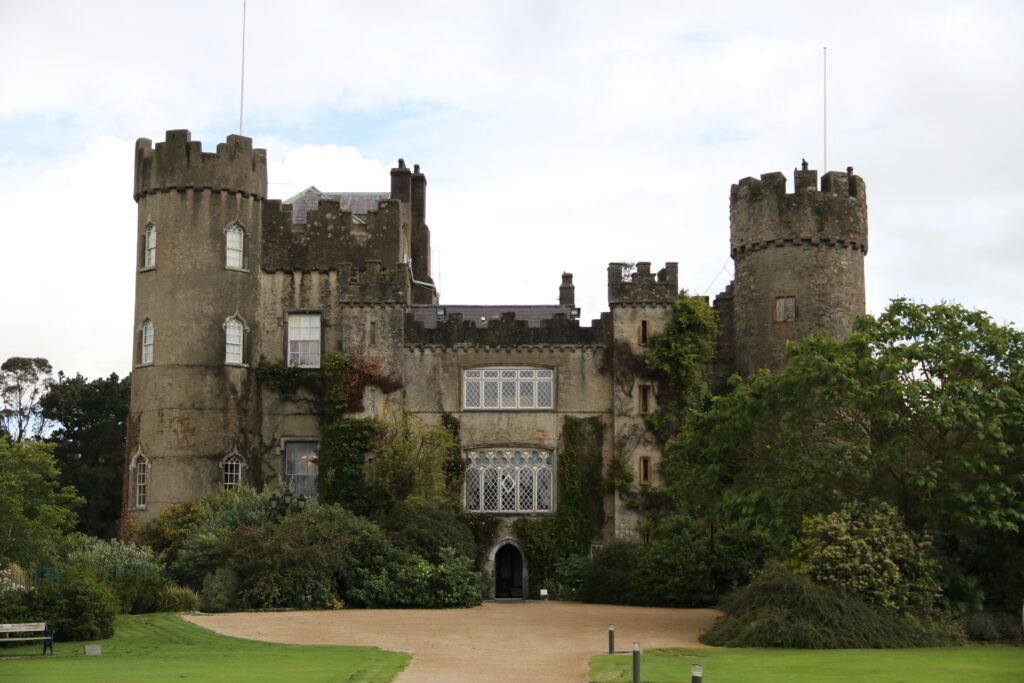
10. Malahide Castle, County Dublin
Malahide Castle, just north of Dublin, was home to the Talbot family for nearly 800 years. This long occupancy is likely why it’s considered one of Ireland’s most actively haunted castles, housing numerous spectral guests.
- The Legend: The castle’s jester, Puck, was said to have fallen in love with a noblewoman. He was found stabbed outside the castle walls, and with his dying breath, he vowed to haunt the castle forever.
- The Haunting: Puck is still seen near the turret where he lived. But he isn’t alone; the castle is also said to be haunted by five lords who died in the Battle of the Boyne, all on the same day, returning to the Great Hall where they had their last meal.
- Visitor Note: Malahide is a fantastic stop for those who want a “soft adventure.” The castle tour is gentle and informative, and the surrounding parkland is perfect for a relaxing walk after hearing the ghost stories.
Are You Brave Enough?
Ireland is a country of beauty, culture, and undeniable mystery. Exploring these haunted places in Ireland allows you to step back in time and walk in the footsteps of those who came before, whether they were lords, rebels, or restless spirits.
But you don’t have to face the ghosts alone. At Irish Experience Tours, we specialise in small group adventures that blend the famous sites with the hidden gems and local stories that make Ireland so special. We provide the comfort, the local guide, and the safety in numbers, you just bring your sense of adventure.
Ready to uncover the real Ireland? Book your small group tour today and let us show you the magic (and mystery) of the Emerald Isle.
FAQs
Can I stay overnight in a haunted castle in Ireland?
Absolutely. Several haunted castles have been converted into luxury hotels or B&Bs. This offers a unique chance to sleep in a historic room with a story, fitting perfectly with our preference for character-filled accommodations over standard hotels.
Are haunted tours in Ireland suitable for solo travellers?
Yes, they are excellent for solo explorers. Small group tours offer a social, safe environment with a knowledgeable local guide. You will have company and reassurance, so you never have to navigate the spooky parts alone.
Do haunted experiences in Ireland focus on jump scares or history?
Irish ghost tours prioritise storytelling, folklore, and history over jump scares. The focus is on local legends and the tragic lives of those who lived there, making the experience immersive and educational rather than just terrifying.
When is the best time of year to visit Ireland for folklore and mystery?
You can explore year-round, but the best time to visit Ireland is October and November, which are special due to Samhain festivals. However, the misty landscapes of spring and autumn add extra atmosphere to exploring ancient ruins and hearing local stories in any season.
Got more questions about visiting Galway and Ireland? Our main FAQs page for answers, tips, and advice about visiting Ireland.